
The principal achievements of great persons often push the fact that they too were real people into a shadow. Snippets do come to the surface, but much stays out of sight unless there is something of the nature of a biography. Kanigel’s book on Ramanujan is an instance, but there are hardly any others.
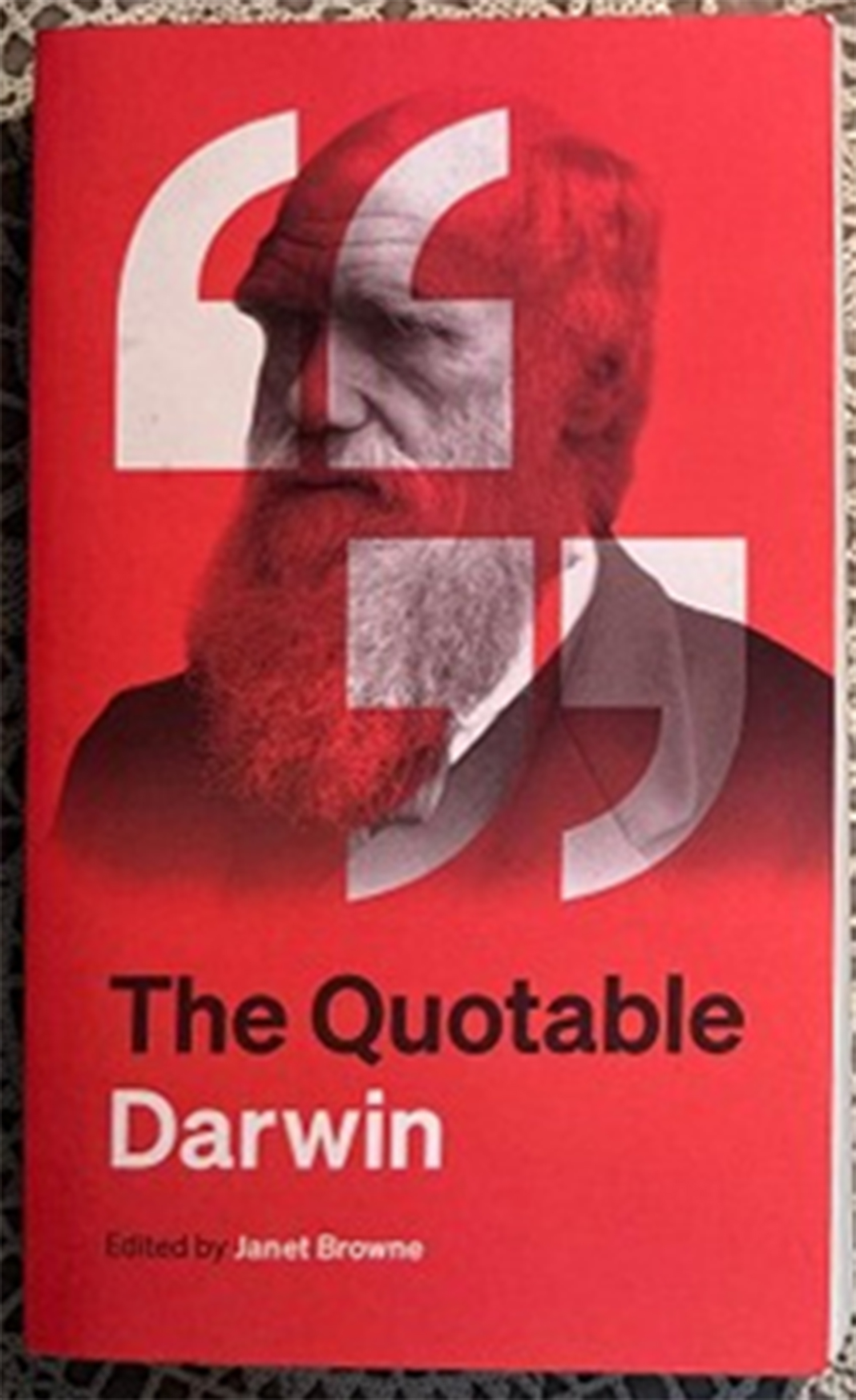
Two collections by Princeton University Press, The Quotable Darwin and The Quotable Feynman deftly bring to life these two icons of the science of our times.
Charles Darwin was the author of On the Origin of Species, the book that deduced natural selection—nature’s method to bring forth new species, the evolution of all living creatures on earth, starting from the primeval single cell. It was a discovery that was unsuspected till it was made, and has not been refined or expanded since. Although the field of molecular genetics has gone deep into DNA structure and mechanics, it was Darwin who worked out how this leads to evolution; and his work was not in a laboratory, it was in the field, observing that changes in the physical environment influenced related species to diverge.
The theory of evolution overturned the concept of humans as a special part of creation and placed all living things within a biological process. Just as the discoveries of Copernicus brought to the common mind the scientific understanding of the wonders of the night sky, Charles Darwin brought rationality and science into understanding the variety of plants and animals, and traced a path that connects the history of all of them.
Many may know that Darwin was to follow his father to be a man of medicine, and, when he did not show the aptitude required, was admitted to the University of Cambridge to study for the clergy. Although he qualified, despite having spent most of his time studying geology and on expeditions with a group of botanists and zoologists, he was spared a life as a minister of the church when he was offered a position as a naturalist to accompany a two-year voyage to the South American coastline.
The Princeton University Press collection, compiled and edited by Janet Browne, describes the five years Darwin spent aboard the Beagle, which was the expedition ship, capturing at once the spectrum of living creatures that Darwin studied and the methodical recording of data, regularly sent back to England. He was a celebrity even before he returned, and his account of the expedition, A Naturalist’s Voyage around the World, was published with great success.
It was over the next twenty years, in retirement in a cottage in Kent, that Darwin pored over his data and came upon the discovery that as animals were always at the numbers that the environment could support, it was the fittest that would survive!
PUP’s The Quotable Darwin cites actual quotations from his autobiography, his lively letters, and his extensive writings and the reflections by his contemporaries, and leads us through the course of his early life, the voyage, his views on subjects like slavery, indigenous peoples, marriage and his personal life, and the course of development of his theory; his transformation from a believer in the Bible, to one who was in direct opposition.
Darwin’s work predates that of Gregor Mendel, who uncovered the first clues about heredity and genetics. Followers of this field, which may be the leading technology of the 21st century, constantly go back to Darwin as the one who first saw heredity in action in a rich and diverse ecological setting. The Quotable Darwin replays the story of the theory taking shape.
Nobel laureate Feynman is easily the most illustrious of physicists of the 20th century. Apart from path-breaking work in theoretical high-energy physics and a pioneer of quantum electrodynamics, he is remembered by countless students, and others too, as a teacher and populariser. The Feynman Lectures on Physics, a transcript of lectures over the two years of an undergraduate course (1961-63) at Caltech, are considered the most valuable introduction to the basics and some advanced topics of the subject, and are preserved like a scripture by innumerable students and researchers.
And there were popular books: Surely You’re Joking, Mr Feynman, Six Easy Pieces, The Pleasure of Finding Things Out and The Meaning of It All, are just a few of the large number of titles that he penned, each one more refreshing and instructive than the last.
One achievement that stands out is the role he played in the Committee set up to enquire into the catastrophic explosion, in 1986, of the space shuttle Challenger, where all seven crew members were killed. Feynman, in his typical way, went into what could have gone wrong and discovered the cause, a frayed rubber washer, but not just that—that the possibility was known and should have been considered.
As the sole dissenter in the fourteen-member Committee, there was tremendous pressure on Feynman not to highlight the failure, but Feynman stood firm and the report was released without his signature. Feynman brought out his version two years later in his book, What Do You Care What Other People Think?
The Quotable Feynman compiled by Michelle Feynman, the legendary physicist’s daughter, is an intimate and eminently readable collection of memorable utterances and writings that have captivated all those who came in contact with them. ‘Whenever I read his words, I hear his voice,’ says Michelle Feynman. She fills the volume with unforgettable quotes that cover his early years, his views on art and music, nature, humour, love, religion and philosophy, science, of course, a chapter on the Challenger, to name a few.
Feynman fans, the world over, are excited every time they get their hands on another one of his many books, to add to their bookshelf. They will be overjoyed to close in on this defining collection from Princeton University Press.
S Ananthanarayanan, retired from the Railway Service, is committed to the dissemination of science. He wrote a weekly column in Indian newspapers on current science for twenty-two years. He is the author of two books, one of them translated into Telugu and Ukrainian.